How to understand problem solving in context
Main-category: Cognition
Sub-category: Reasoning
Sub-category: Reasoning
Contextual explanation: Cognitive process of resolving challenges.
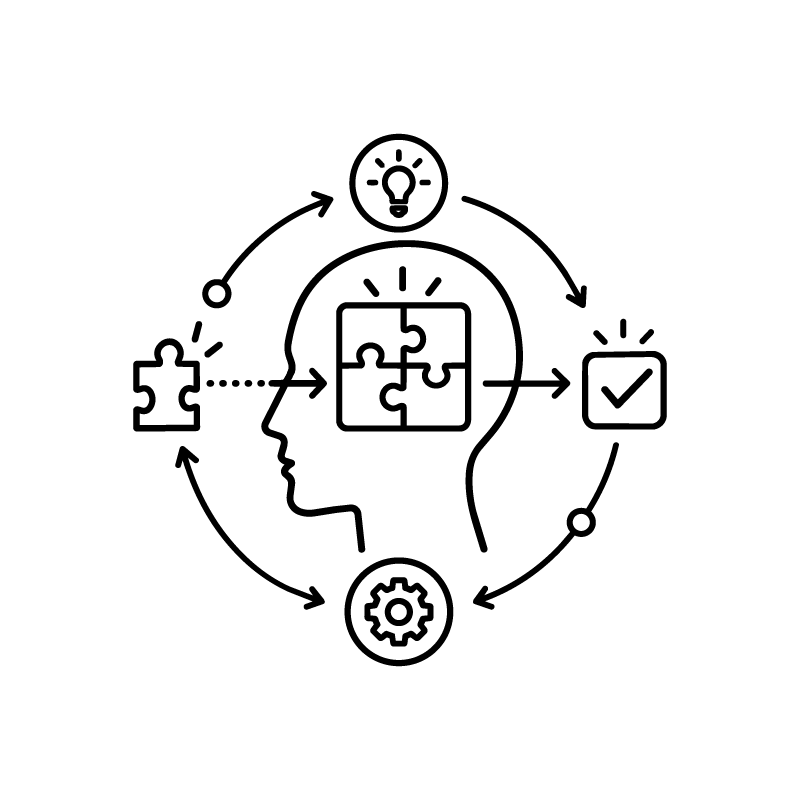
Problem solving is best understood as a cognitive process—specifically, the application of reasoning to identify challenges, analyse their causes or constraints, generate possible solutions, evaluate alternatives, and implement effective resolutions. It is a core mental function that enables individuals to navigate obstacles and achieve desired outcomes through structured thought and decision-making.
Problem solving is best understood as a cognitive process—specifically, the application of reasoning to identify challenges, analyse their causes or constraints, generate possible solutions, evaluate alternatives, and implement effective resolutions. It is a core mental function that enables individuals to navigate obstacles and achieve desired outcomes through structured thought and decision-making.
Themes: Critical thinking and adaptation.
Problem solving is central to the theme of critical thinking, as it requires the ability to analyse situations, synthesise information, and make informed decisions. It is also closely linked to adaptation, since effective problem solving often involves adjusting strategies in response to changing circumstances or new information.
Problem solving is central to the theme of critical thinking, as it requires the ability to analyse situations, synthesise information, and make informed decisions. It is also closely linked to adaptation, since effective problem solving often involves adjusting strategies in response to changing circumstances or new information.
Nuance: Deliberate evaluation and solution generation.
What distinguishes problem solving within its category is its emphasis on deliberate evaluation and the generation of solutions. Unlike routine decision-making, problem solving involves a conscious, stepwise approach to overcoming novel or complex challenges, often requiring creativity, logic, and persistence.
What distinguishes problem solving within its category is its emphasis on deliberate evaluation and the generation of solutions. Unlike routine decision-making, problem solving involves a conscious, stepwise approach to overcoming novel or complex challenges, often requiring creativity, logic, and persistence.